Dr Keith Thomas very kindly did some research for me on the web and came
   up with the following information:

        Jever airfield was four Kilometres south of Jever town [ 53.52 N 07.53E]
   and 7 metres [ 24 feet above sea level]. The airfield was started in 1935 and
   became operational in 1936 with Coastal Fighter Group 136 flying He 51's and
   later Ju 87b, but its contact with the RAF came after the Polish incursion and
   they brought back Messerschmitt Bf 110's and 109's.
FIRST AIR RAID ON THE BRITISH ISLES
     At the beginning of the War the Luftwaffe had only 12 JU 88s
   in the front-line and they were based at Jever operating as Kampfgeschwader
   Wunderbomber 1/KG 25 commanded by Hauptman Helmut Pohle who, at 32, was  a
   veteran who had served as a general staff officer at the Air Ministry in Berlin,
   and had seen combat in the Spanish Civil War.   On 7 September 1939,
   the 2 Staffeln of 1/KG25 were re-designated  becoming 1/KG30 and began an
   intensive period of training with their new JG88s.

   On 26 September 1939 the Luftwaffe mounted an unsuccessful attack on
   Royal Naval carrier HMS Ark Royal and,  as a consequence,  Pohle was
   summoned to a meeting with Goering in which he was told that there
   were only a few British ships making things difficult for Germany
   and that once these had been dealt with, the way would be clear for
   Scharnhorst and Gneisenau to dominate the seas.   Pohle assured Goering
   that his crews were ready to take on the mission and agreed that 1/KG
   30 would move to Sylt from whence the first attack on mainland Britain
   and the Royal Navy ships would be mounted.   Pohle led his 12 aircraft
   in scattered formations of 3, each aircraft carrying only 2 x 500kg
   bombs because of the long range of the mission.   The Luftwaffe intelligence
   staff insisted that there were no Spitfires in Scotland and  Pohle and his
   crews were unpleasantly surprised to be intercepted by the Spitfires of
   602 and 603 Squadrons:  the raiders lost 3 aircraft and 8 aircrew killed,
   Pohle's aircraft was one of the 3 and he became a prisoner of war and
   survived into late old age.

   Source:   The Definitive History of No 603 Sqn RAUXAF


        It was from Jever that Wolfgang Flack flew his BF110'c Zerstörer taking
   out the Wellingtons  heading for Bremen, he didn't get it all his own way and
   came down on Wangerooge.  Why mention him?  The quote is that he was the most
   influential Luftwaffe officer of the World War 2 ...there is a book about him
   and he went on to be a night fighter.  He wasn't long at Jever.

        In the book "The First and the Last"  by Adolf Galland 'The rise and fall
   of the Luftwaffe - by Germany's greatest fighter pilot', there is a report that
   Galland was charged with providing fighter cover for the dash of the three capital
   ships, Gneisnau, Scharnhorst, and Prinz Eugen from Brest to Norway starting on 11th
   February 1942. He didn't have enough aircraft, as many had been sent east, so he
   had them hopping along the Channel coast in shifts to provide a constant 'umbrella'
   over the flotilla.  His last airfield, covering the German Bight, was Jever!

        Here is an interesting extract from the story of Alfred Fane, a reconnaissance
   Spitfire pilot involved in tracking the Tirpitz:

        "After a distance of 1,180 miles and a flight time of five hours 20 minutes,
   Alfred landed at Wick to be rushed off to Operations where he reported what
   he had seen after which, and in his words, there was "a flap" from Group, Coastal
   Command and the Admiralty.

        The Tirpitz now became the priority. Alfred flew another successful sortie
   on 2 February and Flt Lt Tony Hill did the same on 15 February but by now the
   Luftwaffe had to do something to stop these missions from being carried out with
   impunity, especially when the battleship Prinz Eugen, damaged by a mine on
   12 February 1942 during the breakout of German warships from Brest, arrived at
   Trondheim. Hauptmann Fritz Losigkeit, an experienced fighter pilot who had just
   returned from Japan, was told to form Jagdgruppe Losigkeit, the three Staffel being
   formed from 8/Jagdgeschwader 1, 2/Jagdgeschwader 1 and the operational elements of
   Jagdgfliegerschule 1 and 2. Getting to Trondheim was made hard by the weather-they
   left Jever in northern Germany 15 February via Esbjerg and Aalborg in Denmark and
   then Gardermoen in Norway, not arriving at Trondheim until 24 February which
   coincided with the arrival of the Prinz Eugen and Admiral Scheer. The presence of
   more German warships soon attracted the RAF's attentions as one German pilot,
   Leutnant Heinz Knoke recorded in his diary on 26 February 1942:

        'At 1312 hrs our sound detectors along the coast report the approach of
   a single enemy aircraft coming in at high speed. A reconnaissance?'

        'At 1315 hrs, I take off from the airfield alone. I am determined to get
   the bastard. I climb to an altitude of 25,000 feet. Our patrol already in the
   air is ordered to continue circling above the cruiser Prinz Eugen.'

        "Repeatedly I scan the skies for the intruder. There is not a Tommy to be
   seen. Reports from the ground are lacking in precision. They are no value to me
   as they are too vague. After 85 minutes I give up and land again."

        Knoke had tried to intercept a sortie flown by Fg Off Edward Lee whose objective
   was Bergen and Haugesund but Lee only managed to cover Stavanger, some distance
   from Trondhei
Charlie Brown and Franz Stigler incident
        The Charlie Brown and Franz Stigler incident occurred on 20 December 1943,
   when, after a successful bomb run on Bremen, 2nd Lt Charles "Charlie" Brown's B-17
   Flying Fortress (named "Ye Olde Pub") was severely damaged by German fighters.
   Luftwaffe pilot Franz Stigler had the opportunity to shoot down the crippled
   bomber but did not do so, and instead escorted it over and past German-occupied
   territory so as to protect it.   After an extensive search by Brown, the two
   pilots met each other 50 years later and developed a friendship that lasted
   until Stigler's death in March 2008.   Brown died only a few months later, in
   November of the same year.
Pilots
        2nd Lt Charles L. "Charlie" Brown ("a farm boy from Weston, West Virginia",
   in his own words) was a B-17F pilot with the 379th Bombardment Group of the
   United States Army Air Forces' (USAAF) 8th Air Force, stationed at RAF
   Kimbolton in England.   Franz Stigler, a former Lufthansa airline pilot from
   Bavaria, was a veteran Luftwaffe fighter pilot attached to Jagdgeschwader 27
   based at Jever.
Bremen mission
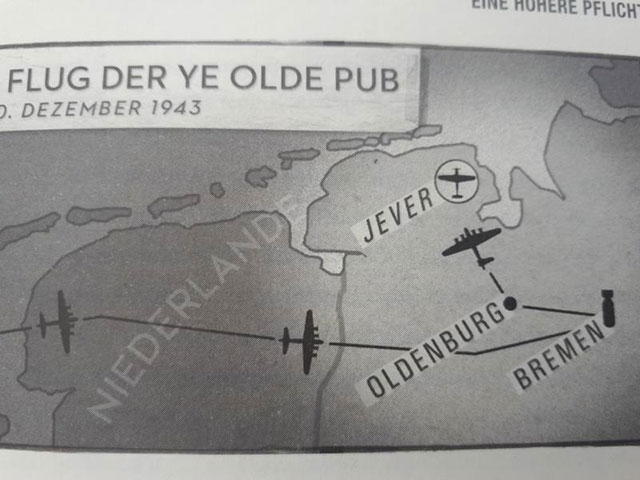
        The mission was the Ye Olde Pub crew's first and targeted the Focke-Wulf
   190 aircraft production facility in Bremen.   The men of the 527th Bombardment
   Squadron were informed in a pre-mission briefing that they might encounter
   hundreds of German fighters.   Bremen was guarded by more than 250 flak guns.
   Brown's crew was assigned to fly "Purple Heart Corner," a spot on the edge
   of the formation that was considered especially dangerous because the Germans
   targeted the edges, instead of shooting straight through the middle of the
   formation.   However, since three bombers had to turn back because of mechanical
   problems, Brown was told to move up to the front of the formation.

        For this mission, Ye Olde Pub's crew consisted of:

   2nd Lt Charles L. "Charlie" Brown (October 24, 1922 - November 24, 2008):
   pilot/aircraft commander
   2nd Lt. Spencer G. "Pinky" Luke (November 22, 1920 - April 2, 1985): co-pilot
   2nd Lt. Albert A. "Doc" Sadok (August 23, 1921 - March 10, 2010): navigator
   2nd Lt. Robert M. "Andy" Andrews (January 14, 1921 - February 23, 1996):
   radio operator & bombardier
   Sgt. Bertrand O. "Frenchy" Coulombe (March 1, 1924 - March 25, 2006):
   top turret gunner and flight engineer
   Sgt. Richard A. "Dick" Pechout (September 14, 1924 - January 5, 2013):
   radio operator
   Sgt. Hugh S. "Ecky" Eckenrode (August 9, 1920 - December 20, 1943): tail
   gunner
   Sgt. Lloyd H. Jennings (February 22, 1922 - October 3, 2016): left waist
   gunner
   Sgt. Alex "Russian" Yelesanko (January 31, 1914 - May 25, 1980): right
   waist gunner
   Sgt. Samuel W. "Blackie" Blackford (October 26, 1923 - June 16, 2001):
   ball turret gunner
Bomb run
        Brown's B-17 began its ten-minute bomb run at 8,320 m (27,300 ft)
   with an outside air temperature of -60 °C (-76 °F).   Before the bomber
   released its bomb load, accurate flak shattered the Plexiglas nose,
   knocked out the #2 engine and further damaged the #4 engine, which
   was already in questionable condition and had to be throttled back
   to prevent overspeeding.   The damage slowed the bomber, Brown was
   unable to remain with his formation and fell back as a straggler, a
   position from which he came under sustained enemy attacks.
Fighter attacks
        Brown's struggling B-17 was now attacked by over a dozen
   enemy fighters (a combination of Messerschmitt Bf 109s and
   Focke-Wulf Fw 190s) of JG 11 for more than ten minutes.   Further
   damage was sustained, including to the #3 engine, reducing it to
   only half power (meaning the aircraft had effectively,
   at best, 40% of its total rated power available).    The bomber's
   internal oxygen, hydraulic and electrical systems were also damaged,
   and had lost half of its rudder and port (left side) elevator, as
   well as its nose cone.   Several of the gunners' weapons had jammed,
   most likely as a result of the loss of on-board systems, leading
   to frozen firing mechanisms.   This left the bomber with only two
   dorsal turret guns plus one of the three forward-firing nose guns
   (from 11 available) for defense.   Many of the crew were wounded:
   the tail gunner, Eckenrode, had been decapitated by a direct hit
   from a cannon shell, while Yelesanko was critically wounded in
   the leg by shrapnel, Blackford's feet were frozen due to shorted-out
   heating wires in his uniform, Pechout had been hit in the eye by a
   cannon shell and Brown was wounded in his right shoulder.   The
   morphine syrettes carried onboard had also frozen, complicating
   first-aid efforts by the crew, while the radio was destroyed and
   the bomber's exterior heavily damaged.   Miraculously, all but
   Eckenrode survived.   The crew discussed the possibility of
   bailing out of the aircraft, but realized Yelesanko would be
   unable to make a safe landing with his injury.   Unwilling to
   leave him behind in the plane, they flew on.
Franz Stigler
        Brown's damaged, straggling bomber was spotted by Germans
   on the ground, including Franz Stigler (then an ace with 27
   victories), who was refueling and rearming at Jever airfield.
   He soon took off in his Messerschmitt Bf 109 G-6 (which had a
   .50-cal. Browning machine gun bullet embedded in its radiator,
   risking the engine overheating) and quickly caught up with
   Brown's plane.   Through openings torn in the damaged bomber's
   airframe by flak and machine gun fire, Stigler was able to see
   the injured and incapacitated crew.   To the American pilot's
   surprise, the German did not open fire on the crippled bomber.
   Stigler instead recalled the words of one of his commanding
   officers from Jagdgeschwader 27, Gustav Rödel, during his
   time fighting in North Africa: "If I ever see or hear of
   you shooting at a man in a parachute, I will shoot you myself.
   Stigler later commented, "To me, it was just like they were
   in a parachute.   I saw them and I couldn't shoot them down."

        Twice Stigler tried to persuade Brown to land his plane
   at a German airfield and surrender, or divert to nearby
   neutral Sweden, where he and his crew would receive medical
   treatment and be interned for the remainder of the war.
   However Brown and the crew of the B-17 did not understand
   what Stigler was trying to mouth and gesture to them,
   and so flew on.   Stigler later told Brown he was trying
   to get them to fly to Sweden.   He then flew near Brown's
   plane in close formation on the bomber's' port side wing,
   so that German anti-aircraft units would not target it,
   they reached open water.   Brown, still unsure of Stigler's
   intentions, ordered his dorsal turret gunner to target
   his guns on Stigler but not open fire, to warn him off.
   Understanding the message and certain that the bomber was
   finally out of German airspace, Stigler departed with a
   salute.
Landing
        Brown managed to fly the 250 mi (400 km) across the
   North Sea and land his plane at RAF Seething, home of the
   448th Bomb Group and at the post flight debriefing informed
   his officers about how a German fighter pilot had let him
   go.   He was told not to repeat this to the rest of the
   unit so as not to build any positive sentiment about
   enemy pilots, lest other damaged bombers hold their
   fire on incoming fighter planes hoping to be rescued,
   only to be shot down.   Brown commented, "Someone decided
   you can't be human and be flying in a German cockpit."
   Stigler said nothing of the incident to his commanding
   officers, knowing that a German pilot who spared the
   enemy while in combat risked a court-martial.   Brown went
   on to complete a combat tour.   Franz Stigler later
   served as a Messerschmitt Me 262 jet-fighter pilot in
   Jagdverband 44 until the end of the war.
Postwar and meeting of pilots
        After the war, Brown returned home to West Virginia
   and went to college, returning to the newly established
   U.S. Air Force in 1949 and serving until 1965.   Later, as
   a U.S. State Department Foreign Service Officer, he made
   numerous trips to Laos and Vietnam.   In 1972 he retired
   from government service and moved to Miami, Florida to
   become an inventor.

        Stigler moved to Canada in 1953 and became a
   successful businessman.

        In 1986, the retired Lt. Col. Brown was asked
   to speak at a combat pilot reunion event called a
   "Gathering of the Eagles" at the Air Command and
   Staff College at Maxwell AFB, Alabama.   Someone
   asked him if he had any memorable missions during
   World War II; he thought for a minute and recalled
   the story of Stigler's escort and salute.   Afterwards,
   Brown decided he should try to find the unknown German
   pilot.

        After four years of searching vainly for U.S.
   Army Air Forces, U.S. Air Force and West German
   air force records that might shed some light on
   who the other pilot was, Brown had come up with little.
   He then wrote a letter to a combat pilot association
   newsletter.   A few months later he received a letter
   from Stigler, who was now living in Canada.   "I was
   the one," it said.   When they spoke on the phone,
   Stigler described his plane, the escort and salute,
   confirming everything that Brown needed to hear to know
   he was the German fighter pilot involved in the incident.

        Between 1990 and 2008, Charlie Brown and Franz
   Stigler became close friends and remained so until
   their deaths within several months of each other in 2008.

        The incident was later recorded by Adam Makos in
   the biographical novel A Higher Call (released in 2012).
   The Swedish Power Metal band Sabaton wrote a song for
   their seventh studio album Heroes, the second track
   "No Bullets Fly".   (Thanks to Marcus Christ.)

        Jever airfield was literally carved out of the
   surrounding forest.   The local rumours claimed that,
   as it was only a grass airfield during the war, it was
   very difficult to recognise from the air and that it
   was never bombed or even discovered by the RAF.

        Keith says he had the same information as me that
   suggested that the airfield was handed over intact
   at the end of the conflict, it was not apparently
   recognised for what it was but Keith's next door
   neighbour in Beethoven Strasse was Vic Azzaro and he
   recollected being attacked while flying over Jever.

        Translation from the German introduction to the
   RAF Jever Open Day 6th June 1959 by Air Chief Marshal
   Sir Humphrey Edwardes Jones KCB; CBE; DFC; AFC; RAF
   Commander-in-Chief, 2nd Tactical Air Force (Germany):

        "An airfield for light recreational aircraft
   from the middle of the 1920s to 1935, an operating
   base for the Luftwaffe from 1935 to 1945 and today,
   a fighter base for the Royal Air Force within the
   NATO defence system - these are the three development
   periods of Jever airfield.

        After the first World War the Focke-Wulf Works
   in Bremen had a small sports airfield built on the
   edge of the Upjever forest.   This was occupied by
   seven light sporting planes.   The Luftwaffe took
   the airfield over in 1935 and within a year extended
   it by felling a large part of the Jever forest to
   form a fighter base.   Hangars, quarters, a hospital,
   and underground aviation fuel dump sprang up in quick
   succession, so that on 1st May 1936 General Mulch was
   able to hand over the airfield in working order to
   the 1st Commanding Officer, Hauptmann Melrich.

        In June 1937 Jever airfield was manned by a
   fighter wing with three squadrons.

        In September 1939, Me 109s and Me 110s were
   stationed at Jever.   They flew their first sorties
   against 22 Wellington bombers, which planned an attack
   on German ships off Schillig and Wilhelmshaven.

        In 1943 additional Ju 52s came to Jever.
   These were used as mine detectors.   Towards
   the end of the war the Me 109 and Me 110 fighters
   were withdrawn from Jever and replaced by Ju 188
   night fighters.

        The Luftwaffe had not extended the airfield
   any further and when the English took it over
   they used it as an auxiliary base at first.

        Between 1945 and 1951 the airfield was
   garrisoned by Poles, Canadians, Danes and
   Jewish immigrants."

   From Volker Ullrich's book "Eight Days in May
   - How Germany's War Ended"   (Thanks to Mick Davis):

        British forces quickly advanced to the Elbe,
   their Polish comrades headed north to take Jever and Wilhelmshaven.
   "In the villages and town districts we pass through (there are) white
   flags and celebrating crowds of liberated POWs and slave labourers
   lining the streets," Skibinski reported.   "At the hotel where our
   brigade was to set up its headquarters, a gigantic Polish flag
   was already flying."   Before entering the hotel, the Polish
   colonel was received by the regional councillor, the mayor,
   and the hotel owner.   "If anyone in the city feels like hurling
   a stick at a Polish soldiers or throwing a stone at anywhere Poles are quartered,
   you three will be hanged and the city will go up in smoke, Skibinski was said
   to have threatened."

        Three days earlier, in the late afternoon of May 3, 1945, something
   unusual had occurred in Jever.   More than two thousand people had gathered
   in the city's largest square, Der Alte Markt, to protest about the plan
   to defend the city against approaching Allied troops.   The senior city
   administrator, Hermannh Ott, tried to pacify the crowd and was hauled
   down from the podium.   The head of the Nazi Party in Friesland district,
   Hans Flugel, did not have better luck.   His exhortations to hold out
   were drowned out by cries of "String him up from a streetlight,
   this golden pheasant."   Two men grabbed Flugel and stripped him of
   his pistols, as courageous citizens raised a white flag from the
   tower of Jever Castle.   They were arrested by a company of naval
   soldiers on the evening of May 4 and taken to Wilhelmshaven.
   They likely only escaped with their lives because the partial
   capitulation of German troops in the northwest of the country was
   announced shortly thereafter.

        Many of Jever's residents were aware of what their fellow
   Germans had done in Poland and feared the worst when the Polish
   forces arrived.   But their terror proved unfounded.   "Originally,
   we were afraid of the Poles, but they behaved beyond reproach,"
   remembered one eyewitness.   Polish troops withdrew from Jever
   and Wilhelmshaven on May 20 and 21 and were replaced by British and
   Canadian units.
|