2nd T.A.F. Blues
.
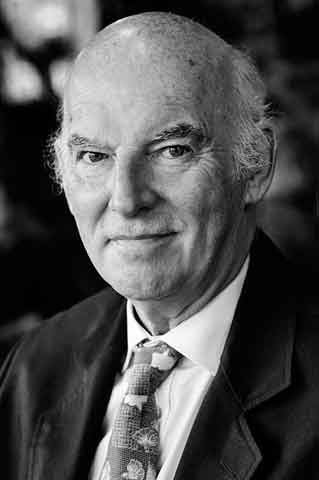
by Mick Davis
(Song) "Oh, I don't want no more of Air Force life,
gee ma, I want to go, but they won't let me go,
gee ma, I want to go home."

     Back in the 1950s, in one of the coldest periods of the cold war, when NATO and
Warsaw Pact forces were huffing and puffing at one another from opposite sides of the
iron curtain, the men of 101 Signals Unit, Royal Air Force station Brockzetel - one of
a series of NATO radar units along the borders of western Europe -  maintained a
round-the-clock watchful eye on the air movements of the communist bloc forces in
their allotted control sector. Together with a number of NATO radio monitoring stations
they were effectively what western political commentators liked to term, the 'eyes and
ears of the 'Free World'.

     This was the decade during which political ideology seemed to boil down to a
simple choice of who was your favourite uncle.

     Was it to be Russia's Uncle Joe, or America's Uncle Sam?   These were the two
main political rivals on the world scene. Communism or capitalism - just take your
pick of one or the other.   Well at least that seemed to be the choice. I can't
remember Britain having any sort of contemporary avuncular figurehead other perhaps
than Prime Minister "You've never had it so good" Harold 'Super Mac' Macmillan.

     However, to be brutally honest at that particular juncture I couldn't have
cared less about political ideology.  As a callow Royal Air Force Senior
Aircraftsman of late teenage years, my immediate priorities were, as I recall,
to indulge as often as possible in an excess of - and here I borrow a line from
a popular song of the era - 'Cigareets 'n' whusky 'n' wild, wild wimmin.'  The
first two commodities were in plentiful supply but, to my great regret, the
wild, wild wimmin were all too frustratingly few on the ground.

     Early in December of 1958, already having served a year in the signals
section at RAF Celle, near Hannover, followed by another at 2nd Tactical Ops
Centre at RAF Sundern near Gutersloh, I was posted to 101 Signals Unit
quartered at RAF Jever (pronounced, 'Yay-ver') in Friesland, north Germany.

     Handed a rail warrant, I was shunted away in one of the unheated,
draughty rat-traps of a truck blessed with bone hard wooden-slatted seats
that served as a second-class railway carriage of the German Bundesbahn.

     Dressed in full military rig, trussed like a Christmas turkey inside
an RAF greatcoat itself strapped over with a bewilderingly-complex system
of webbing accoutrements: heavy belt, various buckled shoulder straps,
mess tins, large and small webbing packs, the lot topped off with a huge
unwieldy canvas kitbag, thus it was - staggering under the weight of all
my worldly goods and chattels - I made my solitary way northwards.

     After one of the coldest, most uncomfortable journeys of my young
life, I was met at Jever railway station by a churl of a Leading
Aircraftsman whose undeclared objective in life it soon transpired was
to paralyse with fear any innocent willing to step into his RAF
Volkswagen combi.

     Depositing me - after a few truly heart-stopping, high-speed minutes
-  outside the camp guardroom, his excoriating parting shot: "101 Signals
Unit? Hmmmph! Bunch of right bleedin' fairies they are, mate!" was my
cheery little introduction to RAF Jever.

     Now before any newly arrived airman was allowed to commence official
duties at an RAF station,  his first task was to get an 'arrivals card' -
more commonly known as, the 'blue card' - signed by the multiplicity of
heads of sections at his new station.  These would include: station
headquarters; airman's mess; medical section, RAF police; sports section,
technical officer, etc., etc.  This was done both for general
administrative and security purposes.

     It was commonly expected the process would be completed within a day
at most.  But for a dedicated skiver this was a task that could be strung
out for three or four days.   However, for the truly experienced column-
dodger anything less than a week would be a contemptible failure.

     For 101 S.U. personnel, the card had to be signed both at the main
camp and at Brockzetel, the radar site operated by 101 S.U., located some
20 miles distant.   Ordinarily, this posting ought to have provided me
with a record-breaking skive, but for some inexplicable reason, (I must
have been sadly out-of-form that year) I'd gathered all the requisite
signatures in just three short days.

     To make matters worse, my first visit to Brockzetel triggered a
small-scale security alert which, for a seasoned operator as myself
with a finely-tuned instinct for anonymity, was extremely unsettling.

     Having caught the early morning bus taking airmen off to the radar
site which left from the airmen's mess, I spent the journey sourly
contemplating the prospects of working underground for the remaining
six months of my tour of duty in Germany, as the flat Friesland
countryside passed before my eyes until, after some 35 minutes I saw
in the distance a large, revolving concave radar aerial fronted by a
line of smaller see-saw type aerials set at an oblique angle.  At this
point the airmen began to hang small security plaques from the buttons
of their battledress jacket pockets.   I noticed each plaque displayed
a photograph of the holder below which in bold type was a number which
I (mistakenly) assumed was the last three digits of their service number.

     As the heavy metal gates of the main compound were swung open by a
corporal service policeman the bus turned in and stopped opposite what
appeared to be a homely-looking bungalow.
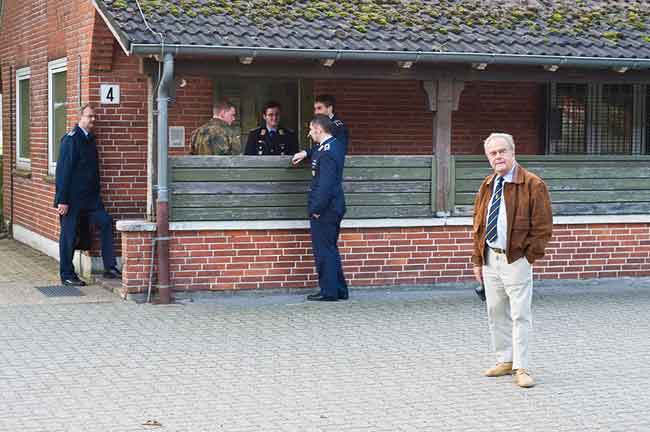
    Phil Riggott outside the 'homely-looking bungalow' during a recent visit back to the site.

     Following the line of airmen into the bungalow, I found myself
in a brightly-lit security office manned by two or three SP's one of
whom held a clipboard and pen.   As each airmen trooped past him they
called out a number which the SP recorded on his check sheet. Assuming
my companions were calling out the last three digits of their service
number I duly sang out my own last three, "640", and continued
following the line of airmen through the office and down a number of
flights of metal stairs which led into the very bowels of the earth.

     Some two hours later, having gained the necessary 'blue card'
signatures, I returned to the surface and re-entered the security
office to find the place in a visible state of flux.   This time
there were at least half-a-dozen 'SP's' milling about, of whom two
or three were brandishing sten guns.

     Spotting my presence, a sergeant SP immediately bawled at me,
Where's your photo plaque, laddie?"

     I explained to him that, as a new arrival who had been getting
his blue card signed, I hadn't yet been issued with one.   My
explanation clearly failed to mollify him.

     "And just how did you get in here without one?" he screamed into
my face.   As I further explained that I had merely followed the other
airmen down into the unit, I rapidly surmised that I was digging
myself deeper into trouble as his eyes bulged ever wider and the colour
of his face changed from mottled red to deep mauve, which was when I
began to have the acutely discomforting notion that his anger would
only be assuaged when my brutally scourged body was swinging from the
nearest gibbet.   (I think it worth explaining at this point that RAF
service policemen - known occasionally  as 'Snowdrops' but more often
by the derogatory title of 'Snoops' -  were not especially noted for
the quality of their intelligence.   Indeed, it was popularly rumoured
that the IQ of the average snoop rarely exceeded his hat size, and if
it did so then never by more than a couple of points).

     Fortunately, at this point, my position was rescued by the arrival
of a Squadron Leader who soon restored an air of calm and rationale to
the situation.

     It transpired that the unit operated a security/safety system
rather like that of a coal mine, where a large board held a series
of individually numbered discs coloured black on one side, signifying
the holder as Out, and yellow on the reverse for In.   As the board
held just 500 discs, when it came time for the SP to transfer the
number (640) I had given him from his written sheet to the disc board,
there had probably been some serious head-scratching before the penny
finally dropped that an 'intruder' had slipped in under the security net.

     Rather than allowing the sergeant to charge me with some unspecified
misdemeanour, the Squadron Leader quietly suggested he direct his ire
towards the snoop who had allowed me to pass through into the unit
unchallenged.  It had been, he concluded, a useful lesson for security
staff to absorb, learn from and, he added with deliberate emphasis,
must never repeat.  Then he instructed me to make myself scarce in the
unit canteen until transport could be found to take me back to Jever.

2nd TAF Blues - Part II

For some must watch, while some must sleep: So runs the world away.
(Wm Shakespeare)

     Whether by accident or design, the powers-that-be at RAF Jever chose to accommodate
the three hundred or so airmen of 101 SU - up to and including the rank of corporal
- in Block number 40, a building situated at the furthermost boundaries of the main
camp - a mere stone's throw from the airfield runway.
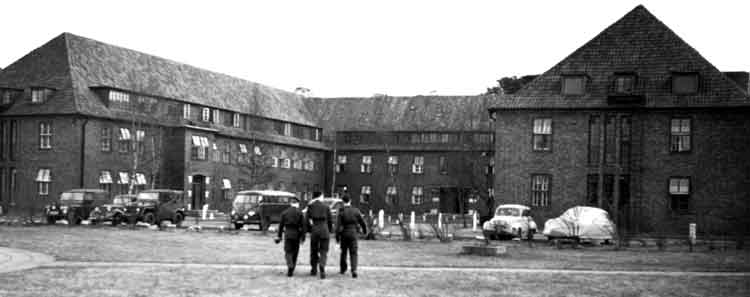
     This was a three-storey H-block building erected during the 1930s, and although the
place could be described variously as, solid, dependable, durable and functional;
'attractive' was definitely one adjective that could never feature in the list.
Indeed, had it ever been aesthetically assessed, Block 40 would have been adjudged
a gloomy failure, to be ignominiously ranked just above the likes of, say, Spandau
prison.

     However, for the next few months this was to be my home, and therefore my most
immediate task was to obtain a serviceable bed (in airman's slang: a 'pit'). This
meant a surreptitious recce so as to secure the combination of not just a decent,
well-sprung bed-frame - one whose springs were all properly connected, and not just
to the frame but, equally importantly, to each other - and a clean, firm mattress, not
the stained, saggy, well-used variety of dubious history whose qualities were guaranteed
to make you feel worse in the morning than you had been last thing at night.

     Experience and cunning were required in this little enterprise. Where no readily
available decent quality example was on offer then it became a simple case of stealthy,
unobserved substitution where one 'relieved' another airman of his bed whilst he was
away on duty or on leave. (At one or two stations I served at during my ten years with
the RAF this practice was so endemic that prized beds and mattresses could circulate
almost as speedily as ugly rumours or dirty jokes.)

     I'd found a vacancy in a pleasant three-man room at the end of a second-floor
corridor with a fine view of the airfield and beyond, which on initial inspection
appeared to be a good move, but on the morning after my very first busy night duty at
Brockzetel, extended by the thirty-five minute return bus journey to Jever, which left
me sorely in need of sleep, I was to discover I had dropped a clanger of considerable
dimension, for no sooner had my grateful head sunk on to the welcoming pillow and I had
blown a mental kiss towards the photograph of a pouting Brigitte Bardot sellotaped to
my locker, than the air was suddenly rent with the most ear-splitting, hellish crescendo.
Windows rattled, metal lockers and beds shook and appeared almost animatedly excited;
an empty mug on the bedside locker vibrated like a demented alarm clock, and the dead-tired
(in this instance, me) were raised to life as though shocked by a high-voltage charge..
Within milliseconds my feet were back on the floor.

     The source of this dreadful racket was soon obvious. Staring out of the window I saw
a pair of Supermarine Swift aircraft hurtling into the sky from the end of the runway,
leaving in their wake a fiendish shimmering mixture of high-octane exhaust fumes in
concert with a hideous storm of decibels sufficient to cause milk to instantly curdle,
babies to cry, birds to turn to stone and fall to earth, and one dog-tired airman to feel
like kicking himself for being such an ignorant, short-sighted fool.

     Curiously, before the end of the first week of night duties, I found myself able to
mentally shut out all intrusive aircraft noise - even the notoriously noisy Swifts - and
sleep the sleep of the righteous without any trouble whatsoever. - it was just a matter
of acclimatisation, and I count myself fortunate in being able to sleep anywhere (my wife
has long said that I'm the sort who could even sleep on a wire).

     Pretty soon I'd settled comfortably into life in Block 40. The sheer variety of
interests and hobbies enjoyed by the disparate (and occasionally, desperate) characters
who inhabited the building rarely ceased to fascinate me.

     They ranged from skilled model makers, photography buffs, radio and electronic
boffins who assembled a variety of clever and useful gadgets; there were artists;
musicians, amateur dramatics enthusiasts, language students etc. The list was long and
richly varied, we even had one character who grew rare cacti warmed by an infra-red lamp
all contained within a large spare locker.

     A clear majority of Block 40 inhabitants were National Servicemen doing their obligatory
two years in the armed services. These were men from every corner of the British Isles, drawn
from all trades and professions who brought with them a wide variety of skills and talents.

     Most were distinctly unhappy to have had their lives and careers interrupted by compulsory
military service. Many kept finely detailed 'demob charts' on which were hand-drawn,
multi-coloured calendars listing the remaining days and weeks to be served before demobilisation.
These charts were maintained with meticulous care, each day and week being ticked off with
ritualistic glee. It was very common to hear a 'demob-happy' airman calling out the precise
number of days and hours remaining until the great day of his release back to 'civvy street'.

     Equally routinely, we regular airmen were subjected to merciless ribbing by the national
servicemen, and thus had to develop pretty thick skins to withstand a fusillade of provocative
questions such as, "Now, tell me, Mick - just how many more years have you got to do?" I had
a stock of well-rehearsed retorts including, "People have been me asking that old chestnut
since long before Pontius ever became a Pilate" or, if I was in a more aggressive frame of mind,
I'd make mischievous reference to the miserable pittance a national serviceman received in
weekly pay - which at that time was approximately thirty shillings (£1.50 in today's money) -
about two-thirds less than a regular airman's pay. "Don't spend it all at once when you get it
on pay day," I would add, twisting the proverbial knife in a little further, but mostly it was
just friendly banter.

     We were paid every second week always on a Thursday in Block 40, in two group sessions -
the first bunch being those with surnames A to K followed by the L to Z's.

     Pay day was eagerly awaited, and as the appointed hour drew near, airmen could become
noticeably excitable, and some went around muttering to anyone within earshot, "The golden
eagle flies today". (Though to be candid, 'flies' was not commonly the verb of choice).

     A couple of tables covered with blankets and chairs were arranged in the large main entrance
hall for the visit of an accounts officer and two sergeants from station headquarters. We were
required to form orderly lines. When your name was called you would march a few paces forward,
call out the last three figures of your service number to confirm your identity, salute the pay
officer, at which his sergeant would consult the pay list and state the correct amount to be
handed over.
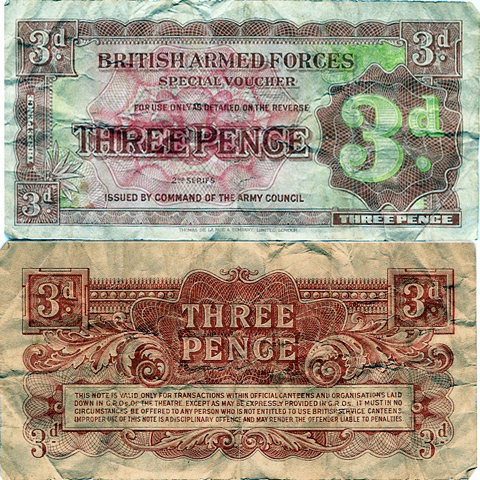
     Payment was made in notes of military script, which in our case were British Armed Forces
Special Vouchers. The notes ranged through about seven different denominations all the way
from threepence to one pound, and were commonly referred to as, 'Baffs'.

     Baffs were also exchanged for Deutschmarks at pay parade. The rate of exchange was then
a very handsome twelve DMs to one pound and six pence, and the DMs had to be pre-ordered. The
trick was to try to ensure you arranged for sufficient to cover the next fortnight's 'rest
and relaxation' away from the air base,

     Usually, each pay day I would exchange somewhere between a third and a half of my wages
for Deutschmarks, and I was also putting away about 25 shillings a week in savings. Average
deductions from an airman's pay were then fairly minimal but at Jever I discovered there was
one punitive subtraction that was sadly all too frequently levied on each and every airman in
Block 40 and which came under the title of 'barrack damages'.

     Every month a senior N.C.O. would make the rounds of the block checking every fixture and
fitting, noting each item that required renewal or replacement be it damaged or missing. This
could be something as small as a sink or bath plug, a light fitting, a broken window or other
damage to the structure of the building attributable to carelessness or general vandalism. The
cost of repair and replacement would be assessed; this amount was then divided by the number
of block residents before each airman had his share of barrack damages deducted from his
monthly pay.

     At other RAF stations at which I'd served barrack damages were an intermittant nuisance
but at Jever they were as woefully predictable as, say, the outcome of a drunken weekend spent
in the Saint Pauli district of Hamburg - though it should be pointed out the latter activity
was costly in more ways than one.

     Just who was responsible for barrack damages was something of a mystery though most of us
thought we knew who could be counted as being among the 'usual suspects'. The block's dustbins
were a regular target for abuse, and for a certain few of the block's inhabitants it had become
almost a tradition, when returning late at night, to carry the dustbins to the first floor
before hurling them over the landing railings with an accompanying cry of, 'Geronimo!' as the
bins made their crashing return to the ground floor..

     But undoubtedly the most expensive month for barrack damages occurred after an incident
late one night when a crowd of 'tired and emotional' cooks (whose motto, as we shall see -
might have been, 'Through adversity to the stairwell'), and who lived on the upper floor of
Block 40 - returned home with the station sports' section's handcart in tow.

     Dragging it through the main doors of the block and up the couple of flights of stairs
to the first floor landing presented them with little difficulty; it was only when they
attempted to manoeuvre it through the somewhat narrower entrance to the second floor
stairwell that the fundamental flaw in their plan became apparent.

     At first all must have seemed possible, because the shafts and the front section of
the handcart passed comfortably through the doorway. However, the handcart's axle together
with its heavy hubs was marginally wider than the door frame and thus its upward journey
came to a sudden halt.

     Sadly, the seemingly uncompromising resistance of the frame to the hubs failed to
register in the befuddled collective consciousness of this drink-fuelled crew and so they
persisted, and because this was a well-built - not to mention, very well-fed - group of
men, they persisted with considerable vigour to the point where the hubs became firmly
embedded in the door frame, but by now having completely exhausted themselves the cooks
finally conceded defeat and retired to bed.

     In the following few days they made repeated attempts to extricate the handcart,
but their efforts were by now half-hearted and lacklustre and so, Excaliber-like, the
cart refused to budge and remained stuck fast there to mock them all until it was
officially discovered and orders given for it to be dismantled by a couple of M.T.-section
mechanics who severed the axle with an oxy-acetylene cutter.

[Special note: Readers of these memoirs may have seen an error  in Part II, where I tell of
that  the incident of the sports section handcart in Block 40. Having revisited Block 40 in
2010 it became obvious the incident could not have happened there. I apologise for this error.
(I now believe this took place at RAF Gutersloh later in my service). However, when I pointed
out the error to  the C.O. of the  Jever Steam Laundry website, Mick Ryan, he took the
sanguine view that as these jottings are mostly an attempt to give a general flavour of RAF
life from an ordinary 'erk's' perspective during those far-off days, it wasn't worth an
amendment.]


2nd TAF Blues - Part III

"...and the busy fret of that sharp-headed worm begins in the gross blackness
underneath." 	(Tennyson)

     We all carry some form of personal emotional baggage around with us and I'm no exception.
In my case it has a name: nichtophobia.

     At first glance this admission might suggest that I suffer from a morbid fear of German
girls saying "nicht", but you'd be wrong - though, sadly, if truth were told, had I a
deutschmark for each of those occasions a fraulein had replied in the negative to my
youthful, sweaty-palmed entreaties, I could have opened my own bank.

[During my stint at RAF Celle there was an enterprising young(ish) local Belle D'Nuit
who sold low-cost favours using a dark green VW Combi van as her mobile 'office'. At
weekends during the late hours, she would park the VW on one of the dimly-lit side
streets in the centre of town. However, the Celle civilian police frequently moved
her on, and thus her regular clientele could find locating her whereabouts to be tricky.
Her 'will-'o'-the-wisp' movements coupled with the fact she suffered from rather bad
acne prompted one very droll RAF station accounts clerk to dub her, "The harlot,
'Pimply' Nell".]

     No, the simple fact is that nichtophobics are afraid of the dark, and thus the prospect
of working underground at Brockzetel represented the realisation of my worst fears.
     For although 'the hole', as we termed the bunker, was illuminated as brightly as Hamburg's
Reeperbahn at weekends - albeit minus the attendant attractions of that once notorious
street - the very possibility, however remote, of a power failure pitching the place into
absolute blackness would fill me with an almost choking sense of dread each time the bus
turned into the Brockzetel compound, and it wasn't until I was in the signals traffic
office and focusing on the work in hand that I was able to suppress these irrational
thoughts.
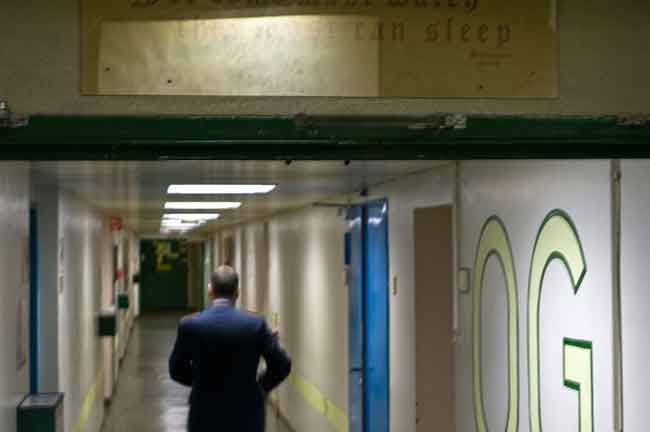
                         Main corridor in the lower level of the bunker.

     As the weeks slipped away so too gradually did my fears as I found the bunker to
be more than adequately equipped to withstand a whole variety of system failures be
they naturally occurring or otherwise. In addition, I found that life as a 'mole' in
Brockzetel, though technically challenging, and on some occasions, mentally exhausting,
was in many respects quite enjoyable, for what also became apparent was that the working
atmosphere below ground was somewhat different from anything I had previously encountered
on other RAF units.

     Discipline and order were always maintained but in a more relaxed, less formal way
than was usually the case. This was probably due in no small measure to the fact that
most of our officers were flying types who tended to treat their watch crews like
responsible adults, providing of course that an individual did his work conscientiously
and to the best of his abilities. This was in stark contrast to the attitude of so many
general RAF station administrative officers who all too often seemed to regard airmen
as a bunch of recalcitrant juveniles in need of constant chivvying.
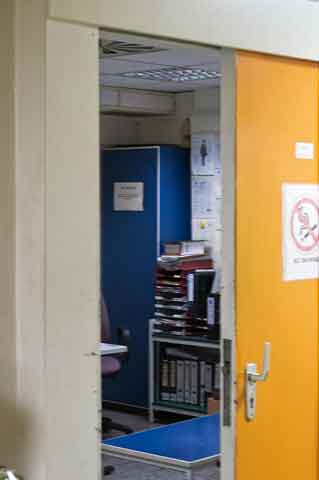
     Our workplace, the signals traffic/cypher office was located through a sliding
door on the upper floor of the bunker, just off the main corridor. It wasn't very large,
about four metres square, a third of which was sectioned off by a three-quarter height
partition fitted with its own sliding door through which was the compact cypher office.
In here was a large safe and a full-length work bench on which sat two Type-X coding
machines. Cupboards under the bench contained various stationery items, rolls of tape
for the Type-X, message pads, etc. Both main and cypher office doors displayed warning
notices reading, Restricted Area: Authorised Personnel Only.  The main area of the signals
office was equipped with eight Lorenz teleprinters and a tape perforator keyboard which
produced 5-unit Murray-code punched tape. There was also a small desk and a comfortable
armchair.

     In daytime the department was manned by two telegraphist airmen, a teleprinter
mechanic and two cypher sergeants of whom Tony Willis was the senior and in overall
charge, but when the day shift ended at five in the afternoon staffing was down to
a single senior aircraftsman.

     Hours of work in the bunker's signals office were almost as flexible as a female
contortionist with shift rotas frequently bent into such testing shapes it was possible
on the odd occasion to experience the weird illusion of seeing yourself coming in the
opposite direction.

     With a full staff the standard shift rota was seven day (8am to 5pm) shifts followed by
two days off, seven evening shifts (5pm to 11pm) with two days off, and seven night shifts
(11pm to 8am) with three days off, but with leave and sickness frequently interrupting the
pattern sometimes it was necessary for us to work seven days on with a single day off,
followed by seven nights, from 5pm to 8am followed by just  two days off. We had some minor
relief in that signals traffic airmen were not required to perform any secondary domestic
duties in the 'hole' for such was the pressure of work on our staff we could not have been
spared.

Juan for the road

     Transport between Jever and Brockzetel for morning and late afternoon shift changes was
by bus, but at 11pm personnel shift transfers were usually limited to signals, the telephone
switchboard, and a corporal police dog-handler together with his canine companion, for which
an RAF VW Combi was used, driven by a green-uniformed, German GSO (German Service
Organisation), and most commonly by an individual whose first name was Otto, but who was
popularly known as 'Fangio'.

     Where other GSO drivers took at least thirty-five to forty minutes for the transfer
journey, Fangio (who strove to emulate his Argentinian racing-driver hero) did it in thirty,
but given the lighter, faster combi, could comfortably shave a further five minutes off that
time.

     However, on the 11pm changeovers, the drive to Brockzetel with Fangio at the wheel,
with forty-five minutes being commonly allowed for the journey, was, by long-established
custom and practice, interrupted at a certain juncture by what might  euphemistically be
described as a 'refreshment stop.'

     For after a kilometre or so following the turn-off from the main Jever-Aurich road on to
the  minor road which led towards Brockzetel, at a certain point Fangio would brake sharply
and take a fast, lurching right-hand turn around to the rear of a dimly-lit Gasthaus where,
neatly and discreetly, he would park the combi in the shadows from where the five of us
would make an equally swift transition indoors.

     I say, 'five of us' because, if our dog-handler happened to be a middle-aged 'Tyke'
corporal named Bert, his huge lion-maned, shambling, but extremely amiable German Shepherd
dog (whose name I've long forgotten) would always be first to arrive at the bar where it was
greeted as an old friend by all and sundry, and while we four humans enjoyed our glasses of
Jever pils the dog would slurp noisily from a tin bowl the entire contents of a large bottle
of Dunkel bier poured, at thoughtfully-timed intervals, by an attentive, dog-loving landlady.

     "I only let him 'av  Dunkel bier," Bert  confided solemnly to me during my very first
'refreshment stop', "cos it seems to be good for 'is arthritis."

     Over the course of a week's shift-changes we took it in turn to pay for the drinks, but
when on the fifth night, Bert indicated it was again the LAC telephonist's turn to pay he was
met with a shaking of the head before the lad said slyly, and very much tongue-in-cheek, "Oh,
no, don't look at me, Bert. We think it's the dog's turn to get 'em in."

     "Ev you gone completely doolally?" replied Bert with heavy scorn before playing his
trump card,  "...surely tha' knows  t'dog dun't 'av any money,"

     Had it ever been necessary, the elderly Bert and his friendly, arthritic,
semi-inebriated dog would have experienced real difficulties in preventing a determined
intruder breaking through Brockzetel's defences, but fortunately the security of the unit was
supplemented nightly by a couple of GSO's together with their Doberman Pinscher dogs and so,
to the best of my knowledge, no uninvited human being ever made it into the heavily-fenced
compound, though  it was commonly rumoured that any unfortunate bird which might overfly the
fence to land on the large T80 aerial would  be speedily 'microwaved' in minutes by the
aerial's powerful radio waves. However, never having been served roasted pigeon, partridge or
pheasant in Brockzetel's barely-equipped mess, I'm unable to confirm that particular story.

Stairwell to arms

     What I can confirm is that the pace of work below ground rarely slackened until around
one in the morning when the teleprinters' mechanical chattering diminished and where I felt
able to relax. At this point I could collect a cup of coffee from the airmen's rest-room -
just a few strides from signals traffic - before sinking into the armchair and opening a book.
The 'Restricted Entry' notice on the exterior door meant that I was most unlikely to be
disturbed, but I was comfortable in my solitude and enjoyed the quiet hours until, once more,
the surrounding machinery rattled back into life.

     Officially I was entitled to a meal break at 11pm in the unlovely 'shed' that was the
above-ground mess, but given that supper was an all-too-sadly predictable, grease-laden plate
of egg and chips, and that my break was commonly interrupted by a telephone call from 2 Group
Signals telling me there was a priority signal coming through requiring immediate attention,
there was little point making my way upstairs, and so  it was that after a few short weeks
I no longer bothered.

     Working the day shift was always something of a strain as signals spewed forth in a
never-ending paper torrent from the 'printers. Each signal had a clearly designated actionable
speed of delivery - marked in the message preamble - ranging from the lowly Deferred, through
Routine, on to Priority, Operational Immediate, and upward to the very rarely-used, Emergency
and the even more rarely-employed, Flash.

     In my time at Brockzetel I never encountered a Flash message but we did have a couple of
Emergency signals whilst I was there, but given the high onus of responsibility carried by
our unit, this was about par for the course. A fair chunk of messages related to the aerial
activities in our sector by NATO's communist counterpart, the Warsaw Pact air forces, and
concerned the initiation of NATO's response to any anticipated threat we might face that
would be directed and controlled from Brockzetel. About ten per cent of messages were sent
in encrypted form and were often designated as 'Priority' or above.

     These kept the two cypher sergeants gainfully employed throughout much of the day, but
at night message en/decryption became the responsibility of the Duty Cypher Officer - one of
the pair of commissioned officers who shared the responsibility of operations room controller,
and who, when first posted to the unit, was required to undergo two weeks intensive cypher
training under the tutelage of Sgt Willis and his companion in the small Cypher office.

     Ordinary airmen in Signals Traffic were officially strictly forbidden to enter Cyphers
for none of us held the higher level of security-clearance required for this work. There was
a printed list of permitted personnel - regularly updated - attached to the inside of the
sliding door of the cypher office, and notices emphasising that entry rules be strictly
observed, but because none of the officers could type at speeds of more than a few words per
minute, an unspoken 'blind-eye principle' was employed in order to ensure the speedy
decryption of any coded message that required swift attention during the night hours.

     And so, in practice, once having been handed the coded message, the Duty Cypher Officer
would firstly ascertain and enter the relevant settings for the Typex decoding machine before
discreetly and politely inviting the airman telegraphist to enter the small office and employ
his touch-typing skills to speed the decryption. Having finished the job it was customary
when the airman returned to his side of the divide, for the cypher officer to offer a quiet
word of thanks. They didn't have to do this but it was a courtesy rarely neglected, and it
was always pleasant to have our effort appreciated.

     Had I ever been called upon to do the whole job of decryption it would probably not have
been far beyond my capabilities, as all conversation that took place in cyphers could clearly
be heard across in the signals traffic area, and thus within a month or so of my arrival, and
without any real mental effort on my part, I had absorbed - almost by a process of osmosis -
the greater part of the necessary technical procedures.

Shaken and stirred by a Martinet

     There's a proverb that holds, Into each life a little rain must fall, but when early in
1959, a certain officer first showed his face in 'the hole', it felt as though a veritable -
if purely metaphysical - deluge had suddenly cascaded on all non-commissioned ranks, for once
Flight Lieutenant (let's call him, 'Martinet' because it has an appropriate ring to it)
entered our lives, it didn't take long for us to recognise that there wasn't going to be any
kind of handy ark in which we could seek refuge, for here was an officer who seemed to be on
a mission to shine a bright light into every nook and cranny throughout every level of the
bunker in order to correct what he perceived to be a pestilential plague of slovenly
behaviour and lack of positive service attitude.

     Word soon filtered through to our office that Flt. Lt. Martinet was carrying out snap
inspections of his operations room watch crew as they debussed, with orders to get hair cut,
uniforms properly ironed and creased, badges polished, etc., etc. Any minor breach of
discipline and good order he encountered was dealt with the issue of a form 252
(disciplinary charge sheet) and before the end of his first week some half-dozen airmen had
been '2-5-2'd'  by him for some kind of service misdemeanour.

     He hadn't taken two strides through the door before we felt the measure of his zeal.
"Don't you stand to attention when an officer enters this room?" he barked, and even though
we were all busy handling signals traffic - which,  ordinarily didn't require such a
reaction - we snapped dutifully upright.

     "Right, now kindly inform Sergeant Willis that Flt. Lt. Martinet is here for cypher
training, he commanded coldly. Within a matter of twenty minutes or so he had 'corrected' both
cypher NCOs for some failure or other of procedural behaviour, and rarely a day passed during
his fortnight's training when he did not make some caustic criticism of Willis, his fellow
sergeant, and the signals staff.  Everything in Flt Lt Martinet's world had to be procedurally
correct to the very last dotted 'i' and crossed 't' in the RAF rule book, but what he was
blissfully unaware of was that his absolute insistence on rules was soon to prove to be
something of an Achilles heel for him.

     A week or so later, one afternoon as I arrived at 5pm for the first of seven extended
night duties, Tony Willis drew me aside to tell me that Flt. Lt. Martinet was listed as Duty
Cypher Officer for that night and watched my reactions carefully. When I smiled ruefully and
told him that I'd "stay on my toes", he nodded thoughtfully and said something about 'treading
with care', then said he'd see me in the morning and went to catch his bus.

Of miscues and mien

     For many a long hour it appeared the night would pass without incident, but around 4am,
as I was absorbed in the exploits of the hero of a Louis Lamour western paperback novel as he
fought with a band of marauding injuns who were trying to make off with a rancher's innocent
daughter, (and why should it be, I've long pondered, that heroines in cheap cowboy novels were
invariably portrayed as being as clean and pure as freshly-laundered, lily-white hankies,
whereas in the trashy, 1950s gangster novels of Hank Janson, the principal female characters
(molls) were painted as being more irredeemably stained and sullied than a jobbing printer's
apron - but here I'm digressing) a teleprinter alarm bell sounded to herald the arrival of a
high priority message.

     Lady Luck could not have smiled more kindly, for the incoming cypher message was
designated 'operational immediate' and, best of all, was a full 900 words in length, which
meant  five pages of letter groups with each group comprising of five randomly arranged, coded
letters. I deliberately waited for the first two pages of the message to emerge from the
printer before going to rouse  Flt. Lt. Martinet from his slumbers in the officers' rest room,
calculating that the remaining three pages would have arrived by the time he was ready to
receive it.

     He looked so peaceful in repose on the camp bed with the blanket tucked under his chin,
it seemed a crime to disturb him yet I delayed for not a moment and shook his shoulder gently
until he came awake and focused his bleary gaze on my face.

     Blinking away sleep he croaked, "What is it?" I kept a noncommittal evenness in my voice
as I gave him the news, "There's an Operational Immediate signal for your attention, sir."
"Very good," he replied, before raising himself up on an elbow and clearing his throat. "Is it
encrypted," he enquired. "Yes, it is indeed sir."

     I was on my way through the door before he chose to ask how long the message was. For
the first time during my period of service in Germany I experienced a delicious sense of what
I now know to be schadenfreude, as I added smoothly, "Five pages long, sir -  900 words in
total."

     When he entered signals traffic a few minutes later his brow was clearly furrowed. I
came to attention and handed him the neatly separated five pages which I had paper-clipped
together, before making a deliberate show of busying myself with various administrative tasks.

     Without saying a word he unlocked the cypher room door, entered, slid the door back again
and locked it. Next I heard him opening the heavy safe to withdraw the daily code book so that
he could enter the necessary settings into the Typex machine.

     Some minutes later, having set up the machine and typed in the preliminary short piece
of code to verify the settings, he commenced typing the jumbled groups of letter code. Now,
when using the Typex, if one made a keystroke error it was immediately necessary to type in
either the letter Q or letter X. If this was done the machine would happily continue, but if
not it would break down and need a complete reset and the whole process would have to begin
again from the start.

     This was a task requiring the skills of a polished, long-practiced touch-typist, not the
ham-fisted, clumsy, single digit keyboard prodding of a complete novice such as Flt. Lt.
Martinet.  Three painfully slow attempts by him broke down well before the end of the first
line of letter groups - I didn't need to count them yet I knew exactly how many groups he had
typed before each separate failure occurred. Eventually, following the third breakdown, I
heard him sigh heavily, push back his chair and come to the separating door. I steadied myself
in anticipation of his next move.

     When he stepped back into signals traffic I again came to attention facing him. "At
ease," he said somewhat awkwardly, "Now, what's your name, airman? I told him. "Yes," he said,
looking around the room but never directly into my gaze. "Well, er, Davis, I had a chat with
Squadron Leader (he mentioned a name) the other day who, er" - and here his voice took on a
pained tautness - almost as though he was about to draw one of his own teeth with a pair of
pliers - "who, er, suggested that if I got into trouble with this cypher thingy, that, er,
I could call upon one of you chaps for assistance."

     I let the statement hang in the air for a moment or two. "That's something I can't
confirm sir, and I don't think it's fair that Squadron Leader (I repeated the name given)
should have mentioned such a thing because, as you must know, sir, we are not on the list of
permitted personnel for cypher duties, and the penalty - were we to be found  in that section
- would be very severe."

     "Yes, I see," he replied, "and I fully understand that, but are you telling me that you
have never given help to any other duty cypher officer?"

     Determined not to make this easy for him I stiffened my resolve, "Yes, sir, that is what
I am obliged to say, otherwise my position is compromised."

     At this point he must have realised he was backing me into a corner, and for the first
time stopped giving me the impression that he was dealing with an insufferable, young Bolshie
upstart (which,  undoubtedly, he was) but relaxed his rigid posture and looked me directly in
the eye. "Look," he said eventually, in a much less authoritative and confrontational manner,
"there's clearly something else at work here that's causing your reluctance to assist me, and
it would be most helpful if you will tell me what it is?"

     "Very well, sir," - and here I chose my words with particular care - "if you want me to
speak freely I will tell you: This is all very much about mutual trust and confidence."

     "Hmmm," he mused, "trust and confidence, eh?. . . . Yes, I see. Well, on the issue of
trust, I can give you my solemn word that I will make no mention of your ever being in the
cypher office and, indeed, if that ever became known to higher authority, I too would suffer
the consequences."

     "Oh, yes," I thought bleakly, "and while you are reeling from the effects of a minor
admonishment, I'll be getting marched in double-quick time through the gates of Bielefeld
M.C.C."

[Military Corrective Centre: An armed services form of prison, and certainly no Billy Butlins'
camp. This place was staffed not with jolly, smiling Red-Coats but hard-faced, and equally
hard-natured, army Red Caps, whose job it was to direct and control the unit's detainees'
daily programme of correction, all carried out with blisteringly high-speed movements.
Certainly not a place for the faint-hearted - and rather like Ratzeputz, -  a highly-potent,
German alcoholic drink brewed in Celle, rumoured to cause drinkers' lederhosen to spontaneously
combust - best avoided if at all possible.]

 - which was where, at that period,  the British Army in Germany - and here I'm searching
desperately for a euphemism - 'straightened out' any warped, twisted, or wayward,
non-commissioned service miscreant.

     However, he now had the bit between his teeth and had sighted the finish line: "All
right", he said in an emollient manner, "will you accept my suggestion that - with your help
and cooperation - we firstly expedite this urgent message and resolve any other related
matters later?"

     That was it. He was clearly seeking a compromise, and it would have been silly for me to
persist because, as he then rightly pointed out,  the message might well have a direct bearing
on every man in the bunker and beyond. And so it was time to haul down the Jolly Roger and do
my rightful duty for Queen and Country once more. Within minutes he had re-set the Typex and
I was applying my best efforts to the keyboard; the decoded printed message tape came
sprinting from the machine at a rate of knots that seemed to take him quite by surprise. All
he needed to do was glue the gummed tape in appropriately-sized lengths to the sheets of a
message pad. In less than twenty-five minutes, nine-hundred groups of jumbled letters had
been duly processed and the job was complete. His relief was palpable.

     "Good, very good," he said, as he sorted and logged the finished result. "Well done.
Now, I will see to this, and return later."

     Within the hour he came back, pulled up a chair, and gave me permission to be frank
and honest, and so I bit the bullet and did my polite best to let him know how resentful
we felt about his constant criticism of the signals' staff, all of whom, I emphasised,
customarily enjoyed the full trust and confidence of the unit's other cypher officers.

     When I finished talking he said little other than that he appreciated my honesty.
He announced he would take away what I'd said and give it further thought. Before leaving,
he asked me not to mention to anyone what had passed between us, and I gave him that
assurance, and so at the morning shift handover I had to sidestep Tony Willis's gently
probing enquiries in relation to the most recent entry in the cypher log.

Belief Encounter

     When I first began my service life I had the youthful notion that British officers were
a special breed. As an impressionable schoolboy I'd read Capt. W.E. Johns' "Biggles" books,
and comics such as The Wizard, The Hotspur and  The Rover with their serial tales of manly
wartime British heroes; watched a myriad number of  war films with actors such as, David
Niven, Jack Hawkins, Richard Todd, Trevor Howard, Kenneth Moore, et.al, portraying
stiff-upper-lipped, heroic figures, and so had the naive belief that, without exception,
our officers were honourable men beyond reproach.

     However, a few short months in the ranks as an RAF Boy Entrant soon disabused me
of this idealistic fiction as, one  fine autumnal afternoon, I was summoned to the
office of the Senior Education Officer for what I was informed was to be a 'career
improvement' interview.

     Shortly after the commencement of the 'interview' I found myself being hotly pursued
around the office as a lusty, white-haired Wing Commander  sought to educate me in a
manner that went far beyond any acceptable curricular boundaries.

     Fortunately I had been forewarned, and having no intention of offering myself up as a
meek and submissive subject I adopted an 'Artful Dodger' routine: bobbing, weaving and
sidestepping his eager clutches until, after what seemed an age but was probably only a
couple of minutes, he realised I was not of his persuasion, and, as it happened - because
he had only one lung from which to draw breath - had simply run out of steam.

     Relinquishing the chase, he leaned heavily against his desk, mouth wide open, gasping
for relief - in the manner of some old, unsuccessful and  unrewarded circus sea-lion who
has wearied of performing -  until he recovered sufficiently to dismiss me with a soundless,
flapping of a hand.

     Curiously I felt no anger towards him, simply a mild feeling of outrage, though I do
clearly remember  some time later  experiencing a sudden flush of relief at my having
survived the encounter wholly unimproved. But though he may have been the first to sully
my rose-tinted view of the commissioned classes he wasn't to be the last.

     At Celle, the Flight Lieutenant in charge of P.S.I. funds,

[P.S.I.  Personnel Service Institute - a body set up to fund welfare and amenities for all
personnel from airman to corporal. P.S.I. shops sold all manner of goods: clocks, cameras,
etc., the profits from these going into P.S.I. funds.]

together with his wife - who,  conveniently, was manageress of the P.S.I. shop - treated
the funds and shop proceeds as their personal piggy-bank. For quite some while they enjoyed
a fine old lifestyle until, inevitably, they reached a point where their submitted accounts
were found to be simply unaccountable, and shortly thereafter a couple of representatives
from the S.I.B. branch of the RAF Police paid them an early morning call.

     And at Sundern, the Station Catering Officer, together with the active co-operation of
the Airmen's Mess Warrant Officer, ran a 'nice little earner' whereby official supplies for
the mess were redirected - through an equally corrupt local German supplier - in exchange
for markedly  inferior victuals along with a cash sweetener of Deutschmarks. This went on
for months until the arrival of a new, keenly observant, and happily incorruptible sergeant
cook, who quickly brought their money-spinning activities to the attention of senior
authority, and who subsequently earned the unswerving gratitude of every airman on the unit.

     But if now I have created  the impression that our commissioned ranks were awash with
paedophiles, embezzlers and racketeers - whose initial letters might  suggest  the 'Per'
bit of the Ardua Ad Astra motto of the Royal Air Force is an unsavoury acronym -  I must
immediately declare this to be completely false as, thankfully - other than for a certain
pompous percentage infected with an insufferable air of  disdainful superiority -  the clear
majority of our officers were commendably decent blokes who generally did their utmost to
keep the old flag flying, and who could be relied upon to uphold the best traditions of the
service.

     However, I feel I ought to mention that, on occasion, I did  encounter some rather
unpleasant exceptions to the rule, happily very small in number,  who were, in my humble
opinion, rather less than worthy holders of the Queen's Commission, and among whom were
a couple of characters I would have been extremely reluctant to follow across the street.
But in happy contrast I also had  the good  fortune to run into a few genuinely
inspirational types whom I would willingly have accompanied to the ends of the earth.

     But here my butterfly mind has been fluttering wildly away from the main thread of
these cobwebbed recollections, so let us now return to the Brockzetel bunker.

From fear to fraternity

     On my late afternoon return journey to the radar site I was contemplating how best I
might cope with further, more searching questions from Willis, but I needn't have concerned
myself because it was a relaxed, cheerful boss who greeted me. Willis had been visited
that very morning by Flt Lt Martinet whom, it transpired, had delayed his return to Jever
in order to engage him in conversation, ostensibly to discuss some minor point of technical
detail in relation to cyphers, but who had then shifted verbal tack to where he spoke of
establishing a better understanding between himself and the signals' office staff.

     Willis was never going to divulge the essential details of their confidential exchange.
But from the snippets he did reveal, it appeared the flight lieutenant might have undergone
something of an epiphany because - to his surprise- Willis had been complimented for the
'thoroughness and clarity' of his cypher training course.

     When, a couple of nights later, it was again Flt Lt Martinet's turn to be duty cypher
officer.  I took pains to ensure that my battledress jacket remained buttoned and my tie in
place and properly adjusted as I was determined not be caught  'improperly dressed', for I
had the uneasy feeling he just might be the type to harbour a grudge.

     At some time after midnight the outer office door slid aside and he breezed in.  I
immediately stopped what I was doing and raised myself to attention. All was tidied and
correctly in its place. As the Reverend William Archibald Spooner might have said, - that
is,  had he been familiar with modern clichès - "I had all my little rooks in a
dough.".

     As it happened, the Flight Lieutenant was in a surprisingly mellow mood. His customary
snap, crackle and popping rhetoric was noticeable only by its absence, replaced now with
calm and measured tones as firstly he told me to continue what I was doing before enquiring
if there was anything in the cypher 'in- tray' requiring his attention.

     When I told him, "Nothing as yet, sir,", I fully expected him to turn on his heel and
depart, but  instead he arranged himself comfortably in the armchair  to watch in silence as
I waded back into the streams of signals traffic still swilling from the printers.

     As the message flow eased I thought he might have seen enough but he stayed seated,
and when I, in turn, was also able to sit down he then began to ask a series of questions:
Where had I trained; was I a national serviceman or a regular airman; how long had I been in
the air force, etc., etc?

     Still wary of him, I answered in the very briefest terms and after a while the
questions ended. Then to my astonishment he suddenly fished in a pocket and produced
a cutting from the Sunday Express which he invited me to read. It  was by the paper's
gardening correspondent who was promoting the benefits of garden composting and how all
manner of plants could benefit from a generous application of well-rotted compost. "What do
you think about that?" the flight lieutenant asked.

     I had to admit that  my experience of gardening was extremely limited. "Limited to
what?" he enquired. So I told him the only thing I'd ever grown were garden peas that, as a
very young boy, I'd planted in the cracks between the paving flags in the backyard of our
terraced house in Lancashire and which, as they grew, I'd supported with a few twiglets. And
when he then asked if I'd had a crop, I had to confess the resulting yield had been somewhat
sparse;  the few peas I was able to shell were pitifully small, pallid as little moons, and
completely flavourless.

     His response was to chuckle before getting me to agree that if I'd fed the plants I
might have had some return for my efforts. However, though he laughed at the story of my
youthful gardening failure, it was evident that he was not laughing at me so much as
laughing with me, and about that point I began to feel less hostile towards him.

     Thereafter, whenever it occurred that he and I were on night duty he began to drop in
for a chat, initially just for a brief visit, but as time went by the visits became longer
and could last for anything up to an hour. He also adopted the  custom, of the other cypher
officers, of bringing two cups of coffee for us whenever, in the small hours, there was a
cypher needing to be decoded.

     Our night time conversations ranged far and wide over any number and variety of topics,
but never included matters relating to RAF service, and nor did he ever refer back to our
initial exchange of words  in the signals office. Once he borrowed a Louis Lamour western
novel from our office 'library' but within twenty minutes brought it back saying that he'd
managed to read half a dozen pages but that was as much as he could manage. In return he
lent me a couple of the early volumes of Henry Williamson's 'Chronicle of Ancient Sunlight',
for which I still remain grateful to him. (My own father had, at the age of 16, joined
the East Lancashire Regiment and served for three and a half years as a Lewis gunner in the
trenches of World War 1. He never spoke much about the war and it was only when I read
Williamson's barely-disguised autobiographical novels with their terrifyingly graphic detail
of the horrors of Flanders' fields, that I gained some small understanding of what my father
and his comrades had endured).

     Never did I come to regard the flight lieutenant as a friend and, indeed, considering
the huge gulf that existed between us - he a middle-aged, ex-WWII navigator whose rows of
tunic ribbons were mute witness to  his having flown through flak and enemy fighters, and
who somehow, with luck and a fair wind beneath his wings, had come through in one piece;
and myself: a barely-out-of-his-'teens, junior-ranking airman who had never had to confront
anything more challenging than his own woeful fear of the dark - this was more than  just
improbable. No, any kind of friendship was simply out of the question, and yet - for
reasons I've never been able to fathom - we became comfortable and relaxed in each other's
company.

     My office colleagues had suspicions that Flt. Lt. Martinet and I had some kind of
understanding because if I was out of the office when he popped in at night for a chat he
would ask when I was next on duty, but I  never told anyone about our night duty
conversations as there was a real chance that some of my friends might come to regard me as
a 'creep', and consequently lose trust in me.

     Gardening, it transpired, was the flight lieutenant's hobby, and once he revealed it
was his intention, when leaving the air force, to live on the west coast of Scotland there to
establish a rose garden and, hopefully, develop an entirely new variety of rose which he
intended to name in honour of his wife. He was raised in the western isles but saw Ayrshire
as being the county where he hoped finally to settle.

     What impelled him to be the stern disciplinarian he could be is something he kept to
himself,  but gradually over time I deduced that his upbringing had indelibly shaped and
defined him. He was s steadfast son of the Kirk whose moral compass needle had  long been
set in unwavering alignment with the iron-clad, righteous certainties of his Calvinist
origins. Yet I also discovered him to be a man of  integrity, humanity and decency who, when
at ease, revealed a pleasant and gentle nature. In addition to respecting him I found to my
surprise that I enjoyed his visits, and also came to realise that I liked him a great deal.
I have always hoped that he achieved his retirement dreams.

Subterranean site-geist

     Some time before my arrival at Brockzetel,  a few airmen of the new German Air Force
began training in the operations room. Initially, it was just a couple of handfuls  of
officers and NCO's, but as the winter of 1958/9 retreated, what had been a mere trickle of
newcomers turned into a spring melt-water rush, and before long there was an almost equal
balance of RAF and GAF personnel.

     Just as 101 S.U. personnel were shuttled between the bunker and Jever, the German
airmen were transported to and from their quarters at the former RAF station at Oldenburg
- which had been handed back to the German Air Force by the RAF in late 1957,  about
eighteen months after the reformed GAF came into being.

     Their officers and NCO's were mostly ex-Luftwaffe personnel, but if it felt somewhat
strange to be in close everyday contact with those who, until relatively recently, had been
sworn enemies, other than for the odd grumble and snort there was never any real
manifestation of ill-will from either side that I ever witnessed.

     Officers sporting British wartime medal ribbons and those wearing former Luftwaffe
decorations  appeared completely at ease in each other's company. This also applied with
other ranks, and when we began sharing the bunker's canteen and rest room facilities there
was a mutually friendly atmosphere. However, we did  insist the  Germans comply with our
habit of forming a polite and orderly queue for refreshments, etc., which,  after some
initial resistance and confusion on their part at being obliged to fall in with this quaint,
old British custom -  necessitating the occasional issue of a terse - but friendly spirited
- instruction, ("Oi, Hermann, get to the back!")  - they happily conformed.

     It wasn't long before both sets of  blue uniforms mingled harmoniously in the rest room
swapping English and German cigarettes, although Players and Senior Service smokes were
universally preferred to the infinitely more pungent German brands with names such as  H.B.,
Roxy, etc.

     (Perhaps it's unfair of me to say that German cigarette brands were less than pleasant
to the senses but  try, if you will, to imagine the scent of new-mown hay just after it has
passed through a camel, to  understand why Brits and Germans alike opted for the superior
refinements of British tobacco.)

[Not to be confused with the popular American cigarette brand, Camel - which, incidentally,
was my favourite choice of 'weed' during a month-long detachment in January of 1961, to
RAF Muharraq, Bahrain.  (Comedian Barry Cryer likes to relate that an American 'Camel'
cigarette advertising billboard of 1950s vintage, displayed a beautiful young woman enjoying
a smoke, with an accompanying caption which blithely announced, "I've tried the rest, but it
takes a camel to satisfy me.")]

     At lunchtime in the above-ground mess, the Germans were allocated a separate servery and
dining area - their food being  transported in insulated containers from their base at
Oldenburg just as ours came from the messes at Jever. (Officers had a separate dining
section).  Ordinarily German and British other ranks didn't share mess tables but, because
of the limited size of the canteen, we were in close proximity and so each group was aware
of what the other was eating.

     Their main courses appeared far more appetising than our own, but equally they were not
averse to casting an appreciative eye in the direction of what we enjoyed for pudding, and
especially on Thursday's when we were served a sweet pancake dotted with sultanas,
accompanied with a heavy dollop of custard. One day I did my bit to improve Anglo-German
relations when invited by a GAF airmen to exchange my pancake and custard for his main
course of wiener-schnitzel and brat-kartoffeln, to which I agreed in a flash -  and this
swap became our habit whenever we met at Thursday lunchtime.

     This wasn't first time I'd served at a 2nd TAF unit being readied for transfer. In
November  of 1957, we'd handed back RAF Celle to the German Air Force (just a month after
Oldenburg was returned to them), and I was then moved to HQ 2 Group based at RAF Sundern (a
non-flying unit) near Gutersloh.

     In my final weeks at Celle, I experienced the surprising novelty of being saluted by
junior members of the newly-arrived German air force. We later found that it was their duty
to salute any rank senior to their own, and though this caused much amusement in our ranks
it was nonetheless a slightly disconcerting experience.

     Brockzetel's signals/cypher office didn't participate in  training German airmen, and
remained the exclusive preserve of RAF personnel. The GAF trainees were concentrated mainly
in the large operations room on the lower floor, learning aircraft movement and plotting.

     Judging by the  increasing numbers of German personnel it was  clear the handover of
Brockzetel was fairly imminent, and, indeed, this happened within a year or so - about the
same time Jever was also returned. To the best of my knowledge, and certainly for the five
months or so of 1959 I remained at the bunker, none of the technical sections were involved
in training GAF airmen, including the near-distant Transmitter and Receiver out-stations.
Apparently their technical system training didn't commence until about 1960, as recently
confirmed by my long-standing 101 SU chum, Phil Riggott, then a Ground Wireless mechanic.

Feature of the black lagoon?

     Mention of Phil reminds me of the night I acted as his 'safety man' at the transmitter
block - located a couple of kilometres distant from the bunker. He says I volunteered for
the job, which surprises me because it was very rare for me to volunteer for anything,  but
I suppose the chance of a  night away from the hectic demands of the Signals Traffic office
had to be seen as a bonus.

     Exactly what duty of care I was expected to perform was never clearly defined to me, but
I was not without a measure of youthful initiative, and remained alert and ready to cope with
any emergency; say, for instance, had Phil been working on a transmitter and been subjected to
a high-voltage charge, I would have leapt into action to find  an non-conducting object -
most probably a wooden broom - with which to safely drag his charred and smouldering carcass
away from the point of electrical contact before making a telephone report of the incident.

     Happily, Phil - like myself, a regular airman - had an ample measure of  technical
ability coupled with a fair amount of  experience and sufficient well-sharpened instincts
(well, he is from Sheffield)  to ensure he stayed well clear of a lethal surge of juice and
so the night passed without incident. What also was a bonus was the fact that we were able
to enjoy several hours of sleep in the building's rest-room -  never an option in the
Signals Traffic office where the norm was the occasional twenty minute cat-nap in the
armchair.
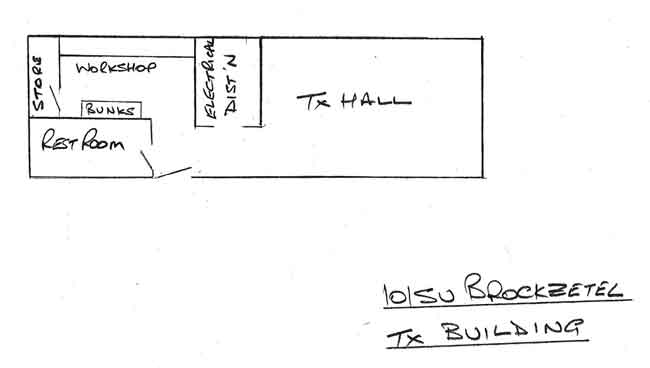
     Phil has provided a rough sketch of the internal plan of the Transmitter building.
Exactly where the place was located I cannot remember, (Unsurprisingly, Phil and I failed
find any trace of  it some forty years later in 1998, when we revisited the area). My only
recollection is that it was a bleakly unremarkable, single-storey, brick building with a
capacious hall in which stood three well-ordered ranks of UHF and VHF transmitter cabinets
emitting a soft menacing hum, from within which, when the main lights were off, a host of
thermionic valves glowed like busy fireflies. The building stood somewhere within the vast
peat bog which was a feature of the area, and though on our return some four decades later we
tried hard to locate it, we failed,  and thus for all we  knew the old place might possibly,
over  time, have been sucked inexorably down into the glutinous, primordial soup of the
quagmire below.

[Since reading a draft of this piece, Phil Riggott called to say the 101 S.U. transmitter
building has now 'resurfaced' on Google Earth. Had it just been bog-snorkelling, I ask?]
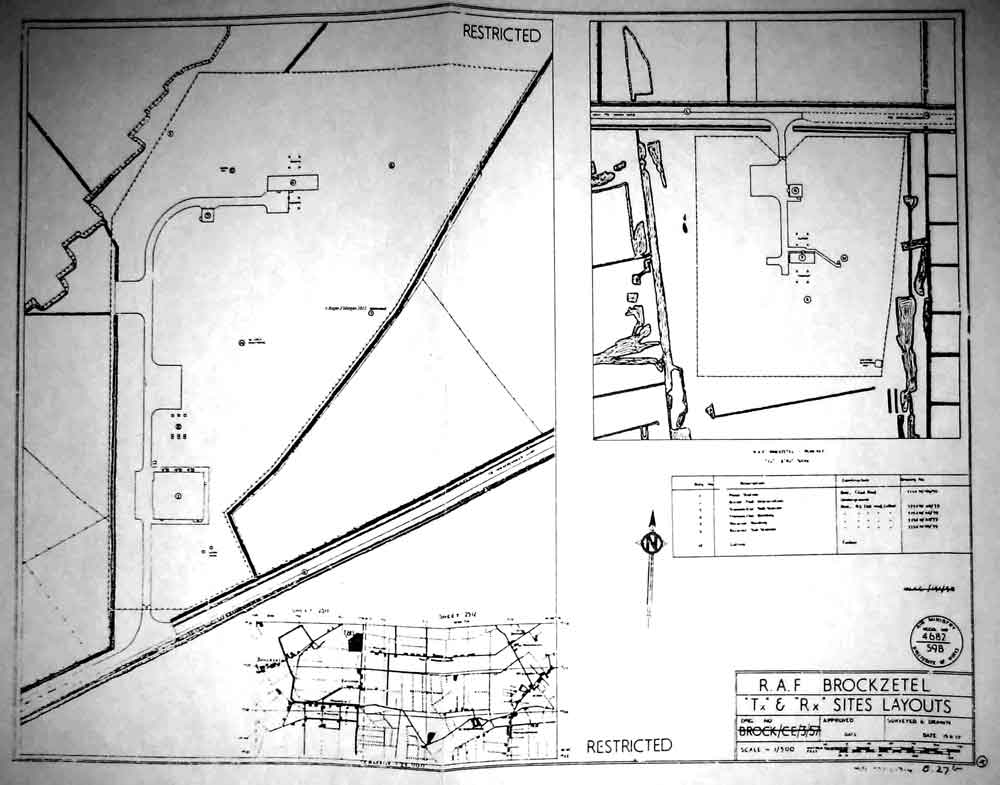
Detailed plans of main 101 SU sites.
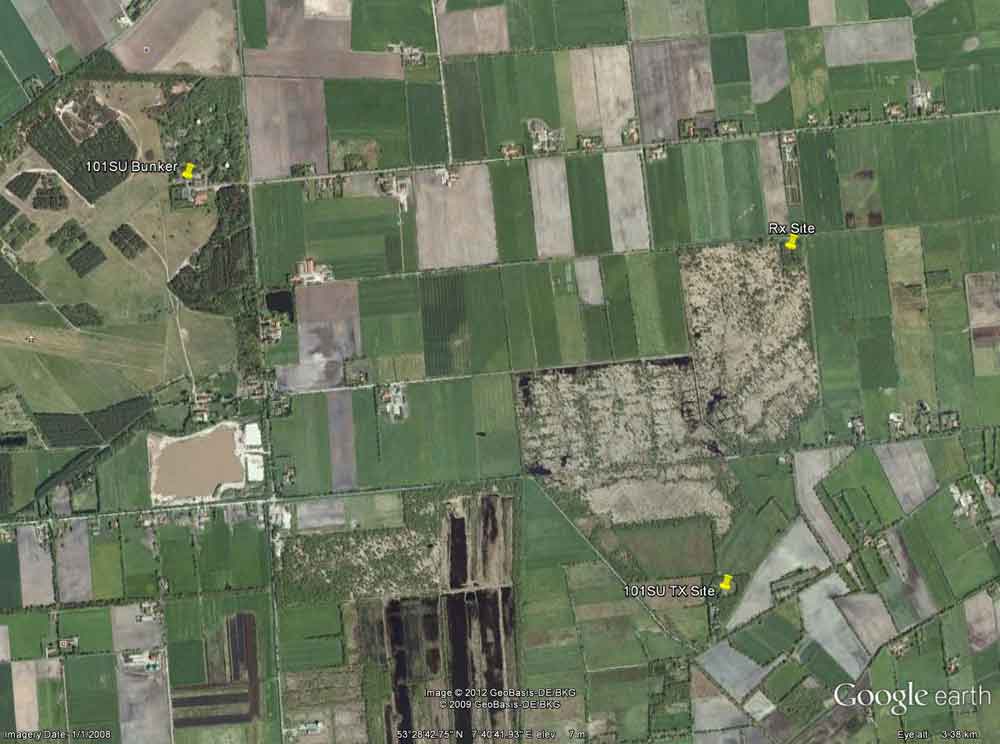
Google Earth shots of locations today.
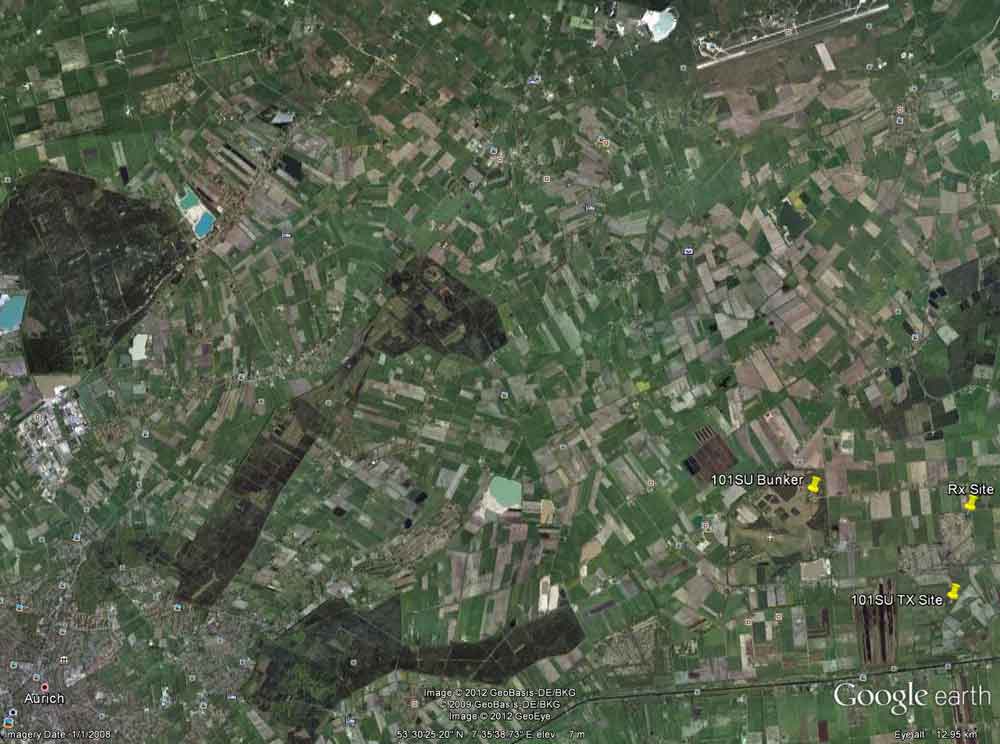
            Google Earth shots of sites location in relation to the town of Aurich.

The High and the Mighty less so.
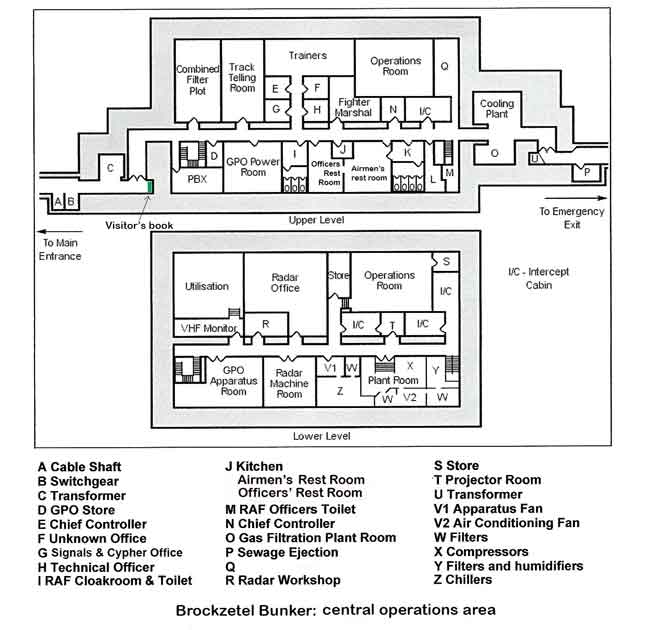
     On entering the bunker by the stairwell and walking the highly-polished seventy-five
or so yards before passing a heavy, dome-shaped reinforced-steel blast door which brought
you to what I always termed, 'the inner sanctum'; one final turn of the corridor and a few
strides more brought you to a pair of swing doors through which was the operational heart of
the bunker. Adjacent to these doors was an alcove, (see on the left in the above plan), in
which stood a small, elegant mahogany side table on which lay a dark green leather-bound
visitors book. Above the desk, illuminated by a brass picture lamp, was a lovely picture of
the young Queen Elizabeth II - and  I can't now recollect whether this was a Norman
Parkinson photograph or a copy of  the portrait, painted during the mid-1950s,  by Italian
artist, Pietro Annigoni, but I do recall that it was a striking image.

     Occasionally I would scan the entries in the book to see if there were any names I
recognised. Most of our visitors were  high-ranking officers from NATO forces, but
politicians sometimes came, most probably to check that we were providing value for money
(the bunker's construction and maintenance costs must have been huge). They were usually
government ministers accompanied by civil service mandarins from the War Office department.
A few of the political figures were vaguely familiar to me, but in honesty, most of them I'd
never heard of. They arrived and were probably briefed on the technical installations and
workings of the bunker before visiting the Senior Controllers' office to look down on the
virtually silent theatre of movement on the spacious operations room floor below, where the
only sounds came from the metallic exchanging of  wall-mounted information boards, (rather
like racecourse tote betting boards) constantly updated by unseen operators working behind
the racks, whilst at the large central plotting table, a ring of airmen plotters were busy
pushing aircraft plots around the  sectors of the mapped table, (something loosely akin to
the old game of battleships) all being directed, through headsets, by the sector controller.

     One name I never uncovered among the multitude of entries in the  book was that of
U.S. Air Force General Lauris Norstad,  who at that time, was NATO Commander-in-Chief. A
couple of years ago, when looking at an official photograph of  Norstad, I realised his
handsome countenance bore a more than passing resemblance to that of Hollywood screen actor,
Sterling Hayden.

     (As you may recall, Hayden's most memorable movie role was as the  mentally-deranged
U.S. Air Force General Jack D. Ripper in Stanley Kubrick's 1960's comedy-drama film,
"Dr Strangelove - or how I learned to love the bomb". Fortunately, for the sake of the
future of mankind, any other similarities between the real and the cinematic General ended
right there, and happily and fortuitously, throughout his tenure of office, Norstad's
mental marbles remained in well-balanced, rational orbit. Unlike Hayden's  Ripper character,
he was never prompted by voices in his head to issue orders for a pre-emptive nuclear strike
against Russia. But  here's a cheery little thought, if he had done so then it's just
possible at some point within the ensuing catastrophic maelstrom, the men of 101 Signals
Unit might have found their bunker to be little more than the world's most expensive
pressure cooker.)

     The Wing-Commander. C.O. at Brockzetel  often ran his eye over the latest entries in
the visitors' book. To his surprise and chagrin one morning he found a most unusual entry:
"L.A.C. Joe Bloggs - On Watch - 22.55."

     As  Leading Aircraftsman Bloggs hadn't bothered to disguise his real identity (which
I can't now remember) he was soon revealed as one of the units' telephonists. By chance,
he was the LAC  who had been with me on the 11pm changeover shift the previous night, and
whose sole topic of conversation on the journey to the site was about his imminent 'demob'.
He repeatedly bragged that his 'chuff chart' -  an  alternative name for 'Demob chart' -
was almost complete, and that as a result we were all 'gripped' - (which meant - in
airmen's slang - that he held a clear advantage over the rest of us).

     Joe  was within  a couple of days of finishing his two years of  national service and
looking forward with relish to his return to 'civvy street'. As was the case with quite a
few national servicemen on the brink of release, he was floating in a mental transport-of-
delight - a condition  we used to refer to as being  'Demob Happy' -  a peculiar state of
mind which, in a few rare cases, could result in a state of euphoric bliss where sound
judgment and commonsense are temporarily suspended - but if Joe had thought his
'signing-on' in the book would not be uncovered until after his departure for the U.K.,
he was shortly to discover that he had miscalculated.

     And so, within a few short hours of his leaving Brockzetel for what should have been
his last trip, Joe found himself heading back in the opposite direction, this time escorted
by a couple of S.P's, whose orders were to deliver him without delay for an appointment in
the C.O's office. Those of us who heard about it, reckoned that Joe's national service was
about to be extended by a period of at least 14 days of  'jankers',

[Jankers: Punishment for a minor breach of the rules where an offender is confined to camp
and required to parade four times a day in full kit at the station guardroom. He was also
given 'fatigues' each evening during his punishment, usually dirty, boring and menial tasks
such as cleaning cooking trays in the airmens' mess. Offenders were known colloquially as
'janker wallahs'.]

but  to our complete astonishment, a few hours later he showed up again in a state of mild
shock grinning sheepishly like a man whose neck has just been spared a visit from the axe.

     Having been invited by the C.O. to explain himself, Joe had shrugged and told him that
he hadn't much to say in answer other than he had simply yielded to a reckless and silly
impulse to add his name to the list in the book before saying his final 'goodbye' to 101
Signals Unit and heading for Blighty. And having made this confession he'd probably
steeled himself in anticipation of the inevitable swish of the blade - but it never came.
Instead, in a wholly unexpected and  rare act of leniency, the C.O. merely handed  him a
bottle of ink-eradicator and ordered him to carefully erase his entry in the book, after
which he would be free to leave.

     A few weeks after Joe's departure I too was on my way back to the U.K., having been
posted to Southern Region Air Traffic Communications Centre at RAF Uxbridge, and though I
would have much rather been posted to a flying unit, the prospect of being just a tube
journey from the centre of London was quite a thrill.

     Exactly what happened to the Brockzetel visitors' book, I have no idea. Occasionally
I look on Ebay to see it's up for auction but as yet I haven't seen it listed. Should any
of the Jever Steam Laundry members know of its whereabouts could  I mention that if
they're tempted to put it up for sale then - in order to add it to my little collection
of RAF memorabilia - I'm willing to go all the way up to a tenner and, for  good measure,
throw in a couple of old Baffs as a sweetener.

. . . . . . .

* May I offer grateful thanks to Phil Riggott & Maurice Gavan for their input, advice
and support to me during the writing of this piece.

